
June 23, 2026 Update
Documenting my builds, progress, and thoughts

What I am working on
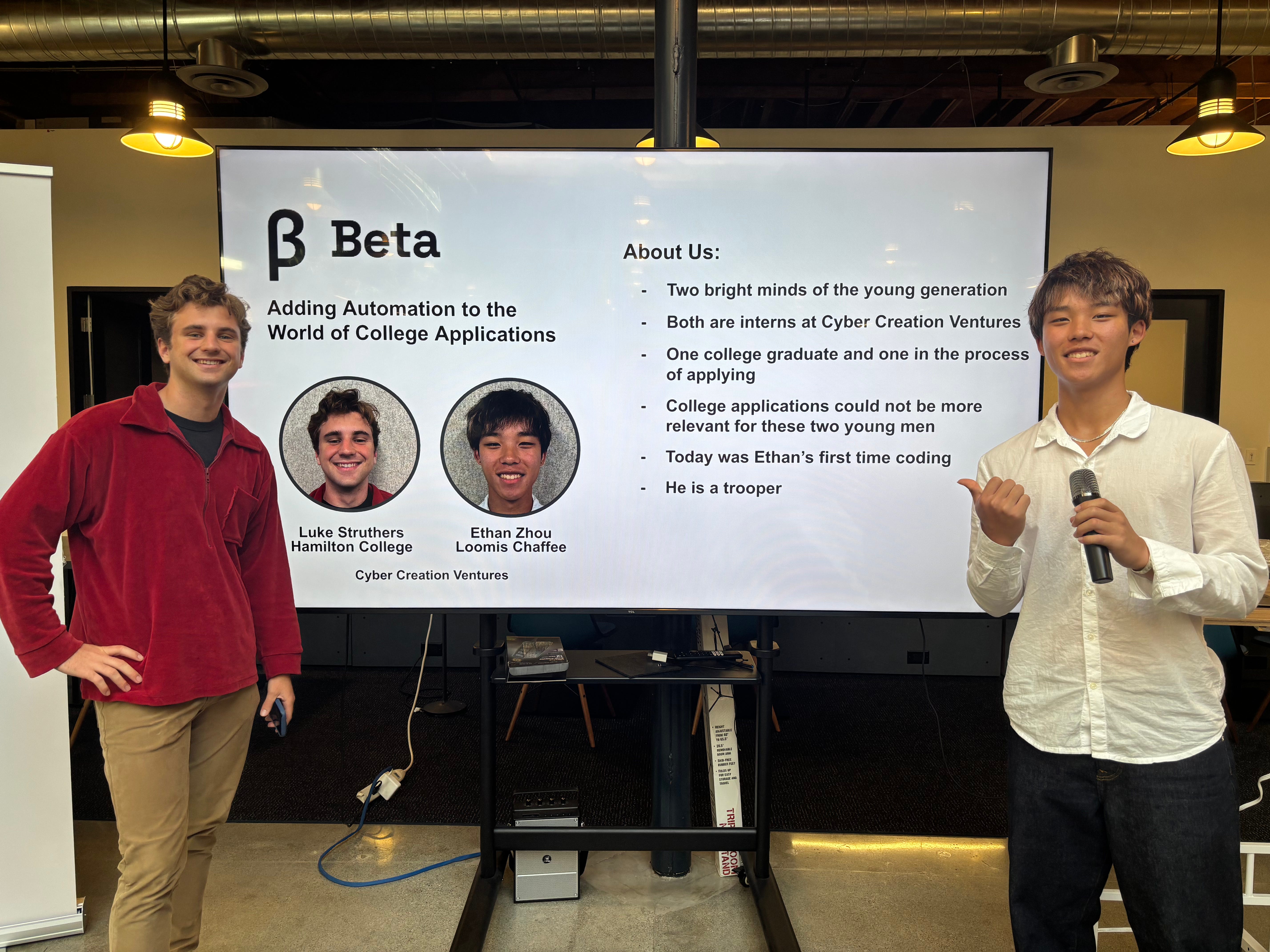
Beta: the College Application Process Manager (Beta Fund AI Agents Hackathon)
My first hackathon, and Ethan’s literal first time using any code product. We came in with a smile and nothing else.
We started with a whiteboard. The method was to put as many things as we could relate about on the board, and if we remembered any problem in that area, we put it as a bullet next to it. We landed on Ethan’s upcoming college application process. He’s a rising junior and an international student at a boarding school, where traveling to colleges isn’t always an option. I had dealt with applying to college during Covid, when indicating interest was difficult. So the issue came up.
The beta idea came after we chose the college process. I asked Claude to make some David Epstein-esque connections between the other issues on the board and the college application problem. The VC frame of building a portfolio reminded me of calculating a beta and Sharpe ratio — reminiscent of an asset allocation project from the fall. We went from there. We built an AI dashboard that used agents to fetch college info and matches based on your collegiate preferences and risk tolerance. We also tried to implement sourcing for college interest indicators, so we could decrease the risk of every asset (application). We didn’t calculate a Sharpe ratio for our college application portfolios. Looking back, that was a missed opportunity.
Splitting work with Ethan was smoother than I could have imagined. I got him signed up on GitHub the night before and onto Claude Code and Cursor. We took photos of our work breakdown and fed those to the models, and made it imperative to avoid overlaps until we merged. For the last thirty minutes, we coded off one computer to ensure no merge conflicts. Stressful, but it worked.
I really thought we weren’t going to present. We didn’t have the website hosted and the slides weren’t ready when 4:00 came around. Then I suddenly realized, “oh my god, we can present this. This is decent enough.” After we got our project submitted, I turned to Ethan and said “we may just win.” In the end, we didn’t win and weren’t really that close. One regret: we didn’t meet the other contestants until after the pitches. Apparently, making friends with the other groups is a great way to get votes.
For my first hackathon, and for Ethan’s literal first time using any code product, I wouldn’t have changed it.
The Networking River
The Networking Control Tower is now a Networking River. The idea is still the same but the content and focus has been honed in.
The River is focused on creating a current of information that flows you in the right direction, with or without user input. The idea came from competing in the Beta University hackathon, where the judges were placing emphasis on making a product that isn’t just a user dashboard.
The platform runs on a Node.js and Express backend with a plain JavaScript frontend, no bundler or build step. All data persists in a single SQLite database, so companies, investors, contacts, and every agent output live in one place and stay in sync. The “current” behavior comes from a scheduler built on node-cron. Agents fire on a timer rather than waiting for user input, pulling fresh data through the Exa API, writing outputs back into the database, and surfacing what matters into the action queue or a daily email digest. Every agent follows the same pattern: read structured rows from the database, build a prompt, call the Anthropic API with a fixed token budget, and write the result back as new records. That uniformity is what makes adding a new agent additive rather than structural.
The new highlights are the agents that push the individual in the right direction. The outreach agents include:
Company Discovery — queries Exa for emerging companies matching your target sectors and stages, then scores and ingests them into the pipeline automatically.
Company Signal Monitor — watches your tracked companies for funding announcements, hiring surges, leadership changes, and press coverage. Each finding is stored as a scored signal with a confidence rating and source attribution.
Relationship Pathfinder — cross-references your investor and contact list against companies in the pipeline to surface warm paths you might not have noticed. It asks Claude to reason about who you know, who they know, and which connection is worth developing.
Opportunity Investigator — runs a deep-dive on companies that have accumulated enough high-confidence signals. It pulls together everything in the database — signals, company profile, funding history — and produces a structured intelligence brief: business model, leadership, why now, and open questions worth asking.
Follow-up Strategist — scans your tracked relationships and pending actions, identifies who is overdue for a touchpoint, and drafts a recommended next move based on how the relationship has progressed.
The upkeep agents run on longer cycles and are responsible for keeping the knowledge base clean and improving over time rather than generating new outreach:
Evidence Auditor — deduplicates signals across agent runs so the same funding announcement doesn’t surface three times. It compares new findings against stored signals using semantic similarity and flags or merges near-duplicates before they pollute the feed.
Company Profile Curator — periodically re-enriches company records by pulling fresh data from Exa and asking Claude to reconcile it with what’s already stored. The result is a versioned, timestamped company intelligence record covering description, products, customers, leadership, and hiring.
Outcome Learning Agent — watches what you actually do with the drafts and suggestions the system produces. Every approval, skip, and sent message is recorded as an outcome event. The agent periodically analyzes those outcomes and generates adaptation proposals — suggested changes to agent parameters like batch size, confidence thresholds, and outreach timing — which you can review and apply or reject.
Investor Mapper — discovers and confirms investors behind the companies in your pipeline, enriching each record with firm, role, stage focus, and sector focus so the outreach agents have accurate targets.
New Feature: The Taste & Preference Tuner
This feature helps the user hone in their narrative through simple this-or-that selection. It curates a taste profile that helps the agents understand the user’s preferences, outreach comfortability, and the strategy the user hopes to use for their networking.
I based this feature off of tools like Dragonfly Cave’s favorite picker and Would You Rather. The insight being that forced pairwise choice reveals preference far more reliably than a survey ever could. When someone has to pick between two specific things, they reveal what they actually value, not what they think they should value.
Technically, the Tuner works in three layers. The first is the duel feed — every session, the system assembles a mixed deck of pairwise comparisons pulled from nine categories: outreach tone, ask type, contact channel, research priority, specific companies, investors, events, fresh signals, and relationship paths. Every option in the deck carries a tags array so the system is learning over attributes, not just surface-level names.
The second layer is the preference event log — an append-only database table that records every choice (left, right, neither, both, skip) with the full JSON of both options and their category. Nothing is overwritten; the log only grows.
The third layer is Claude distillation — when you hit Refine, the system sends the last 80 events to Claude with a prompt asking it to synthesize a 120-180 word taste profile covering your outreach voice, the kinds of companies and people that excite you, the moves you’re comfortable making, and any clear patterns worth noting. That profile is stored on your user record and injected directly into every outreach draft the system generates. The more you tap, the more the drafts sound like you.
What I am listening to / reading
Build by Tony Fadell
I finished Build by Tony Fadell. The last few chapters focused on team management and becoming a CEO. While that doesn’t apply to me directly, the themes of staying grounded and not becoming entitled to the perks around you landed. The main conclusion — “Products and People are what define your career” — is something I want to carry forward. I look forward to bringing my skills and personality to any team I work with and building products that reflect the care I put into them.
Lenny’s Podcast
As luck would have it, Tony Fadell went on Lenny’s Podcast the same week I finished his book. The timing was perfect. He discussed the AI + Hardware theme that is ever-present in SV right now, his excitement around “really good AI that you can trust,” and the companies his Build Collective fund backed early. As a new entrant in the market, it is my take that the wave has hit and is passing. I’ll have better luck looking to the horizon, scanning for the next big set.
How to Win Friends and Influence People by Dale Carnegie
I have never had a more social job than my role at CCV. Far from the remote engineering internships of the past, where I was often isolated working alone out of a cabin in the Catskills. In my attempt to stay conscious of my communication style, I’ve begun listening to Carnegie’s well-regarded book on the subject. Most of the teachings are common sense. The best connections, in business or otherwise, come from demonstrated and real interest in what others are producing. In my role as a VC analyst, I can try to genuinely relate to the founders and understand their perspective. Even when I can’t offer further interest, I can provide my time and attention.
Something that’s interested me:
I spent a good chunk of this week in Claude’s design interface, running two different animation experiments.
The first started with some pixelart I created of a man rowing down a stream. I wanted to turn it into a looping pixel art animation for the Networking River. What came out the other side is what you see on the platform now. Getting there was a lesson in specificity. The model had a hard time with spatial reality — objects clipping through each other, layers rendering in the wrong order, movement that felt mechanical rather than natural. Once I started treating it like a collaborator who needed real-world reference points, things improved. I started describing the oar movement in clock positions: “the oar enters the water at four o’clock and exits at eight.” That kind of concrete physical framing landed much better than directional descriptions. Pushing hard on layering logic and making sure the animation had consistent depth eventually got it to a place I was happy with, but it required a lot of back and forth to get the model to hold the physical reality of the scene.
Starting Image:
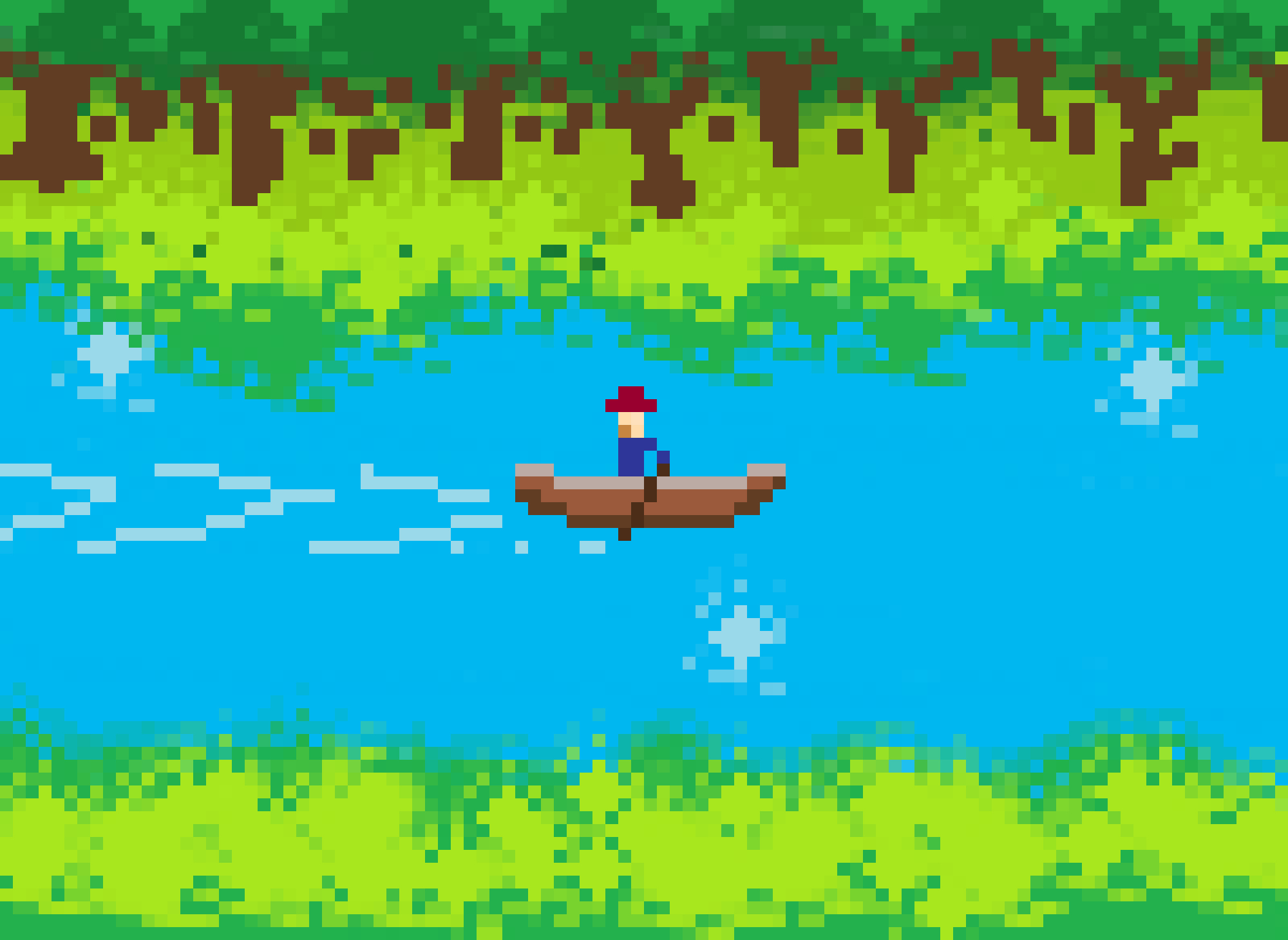
Ending Animation:
The second experiment was for my portfolio site. I have a pen-and-ink drawing I wanted to animate, specifically the waterfall in it. I gave the model just the black and white original, and it did something impressive: it correctly identified which parts of the drawing were flowing water and which were static rock, and built a mask around that segmentation. For a hyper-realistic ink drawing with no color cues, that was genuinely good. Where it fell apart was in what came next. Once the mask was in place, it defaulted to a simple scrolling line effect that just doesn’t look right. It knew where the water was. It didn’t know what water does. Animating realistic fluid from a still illustration is probably a stretch goal for where the tool is right now, but the image reading was a real bright spot.
Starting Image:

Ending Animation